A reader asks:
Is suffering a mystery? What is “redemptive” suffering? How is it different from penance?
I’m reflecting on my mother’s many sufferings. And my father’s too. At my worst moments, I begin to allow doubt to creep into my heart.
She would often say “keep walking, one foot in front of the other.” That was a sign of her great faith in God.
My father’s was that he was saying the rosary when he died in hospital after many years of pain and suffering.
I’m the youngest of eight. My father had a major stroke that left him hemiplegic six months before my birth. My mother was faced with a terrible situation since my father couldn’t work for at least a couple of years.
My father was stuck in a wheelchair chair for the last 8 years of his life. He died in hospital at 67.
My mother herself had a stroke and became hemiplegic a year after he died. She died 7 years later at age 69.
I had three legally blind siblings, a sister and two brothers. One of those brothers had schizophrenia and the other was autistic. The sister fell down a flight of stairs and died at age 58.
I feel as if listing this out makes it look like some kind of sick joke. But it isn’t, it all really happened. These 5 family members suffered the most yet had the deepest faith.
What is God’s plan?
“Thou indeed, O Lord, art just, if I plead with thee, but yet I will speak what is just to thee: Why doth the way of the wicked prosper: why is it well with all them that transgress, and do wickedly?” Jeremiah 12:1
Discipline and Refinement in Hebrews 12:5-11 states that God disciplines those He loves like a father chastens sons, producing righteousness and peace through endured suffering.
Testing Faith in 1 Peter 1:6-7 describes trials refining faith like gold in fire, proving its genuineness for praise at Christ’s return.
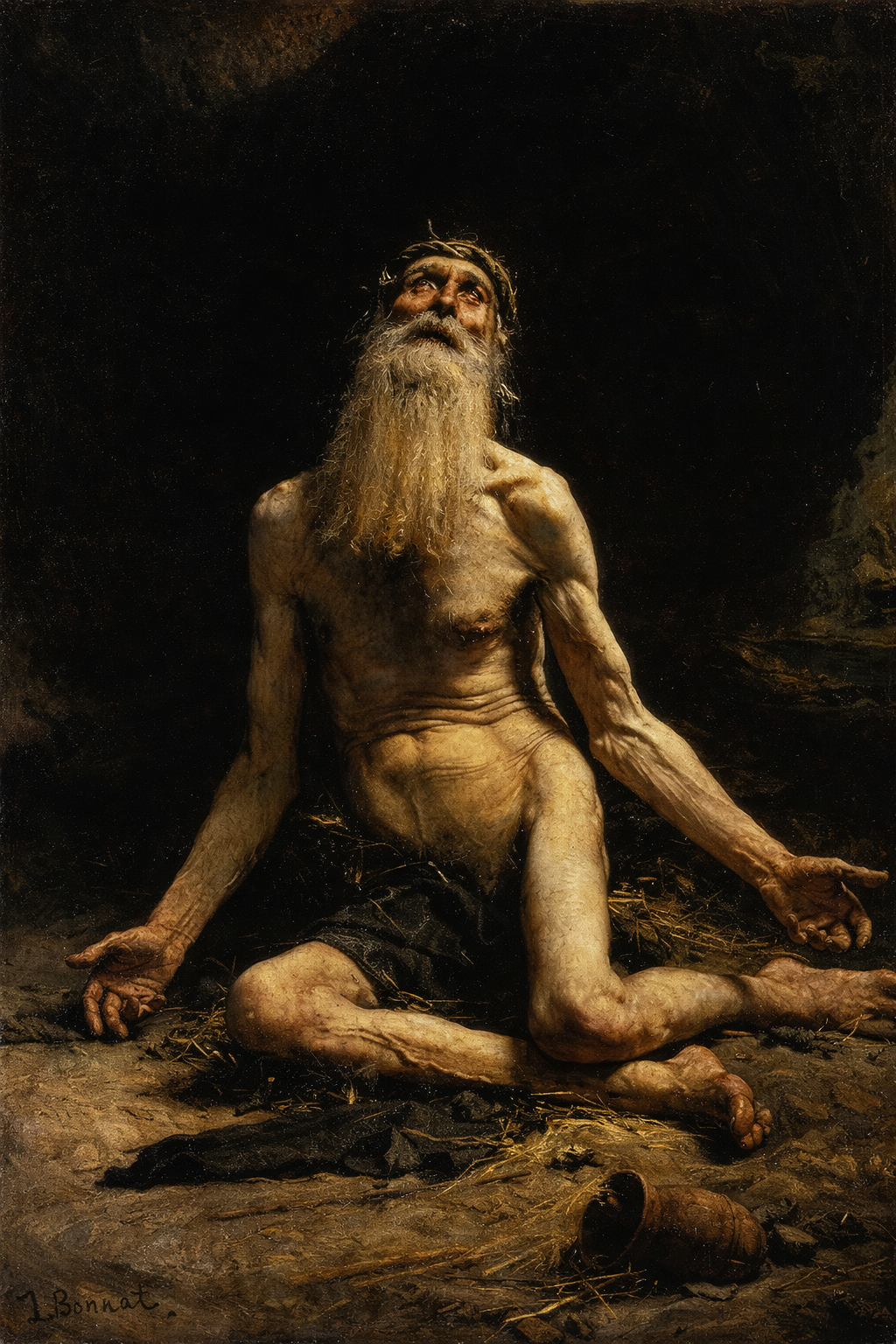
Job 1:1 portrays a blameless man tested to demonstrate unwavering devotion.
Participation in Christ in 1 Peter 4:12-13 urges not to be surprised by fiery trials but to rejoice as partakers in Christ’s sufferings for future joy. 2 Timothy 3:12 warns all godly in Christ face persecution.
Promise of Deliverance in Psalm 34:19 affirms many afflictions befall the righteous, yet the Lord delivers from them all.
We answer:
Suffering is a mystery, but not a sick joke and not nonsense. In your family I see something very specific: God allowed you all to live very close to the Cross.
You grew up with a father disabled by a major stroke before your birth, in a wheelchair for 8 years, dying at 67 saying the Rosary. A mother who faced all of this, then had her own stroke after his death, yet kept saying, “One foot in front of the other,” and died at 69. Three legally blind siblings. Schizophrenia. Autism. A sister who died at 58 from a fall.
When you list it out, it almost sounds absurd. That feeling is honest. It is what Job, Jeremiah, and the Psalmists felt: “Lord, this looks wrong.” But notice what you yourself saw: the ones who suffered most had the deepest faith. Your mother’s phrase is not just pep talk. It’s a spiritual stance: “I do not understand, but I will keep walking with God.” Your father dying with the Rosary in his hands is not an accident. That is a man clinging to Our Lady and Christ in the middle of what seems like defeat.
In Catholic terms, suffering is a “mystery” not because it is random, but because it is so deep we can know it truly, but not completely. We know some things clearly. Suffering enters the world through sin, through the Fall, but God does not enjoy our pain (see Lamentations 3:33). Christ did not come to avoid suffering, but to enter into it, pass through it, and conquer it. Scripture tells us suffering can discipline and refine us (Hebrews 12:5–11), prove and purify our faith like gold in the fire (1 Peter 1:6–7), unite us to Christ and His Cross (1 Peter 4:12–13), and be part of our path to holiness and heaven.
What we cannot see from here is the whole pattern. From our side, life looks like the back of a tapestry: knots, tangles, and loose ends. From God’s side, there is order and meaning. So yes, suffering is a mystery, but a saving mystery if it is joined to Christ, not a cosmic joke.
Now, redemptive suffering. Christ’s Passion and death are complete, sufficient, and perfect. We cannot add to the Cross in itself. Yet St Paul says something shocking: “I rejoice in my sufferings for your sake, and in my flesh I complete what is lacking in Christ’s afflictions, for the sake of his body, that is, the Church” (Colossians 1:24). Nothing is lacking in the value of Christ’s sufferings. What is “lacking” is our participation.
Redemptive suffering means: suffering that we freely offer to God, united to Jesus’ Passion, for love of Him and for the salvation and sanctification of souls. We try to live in a state of grace, going to confession when we fall. We consciously offer what hurts: “Jesus, I offer this to You. Use it as You will: for my own conversion, for my family, for souls.” We try to carry it with faith, even when emotionally we feel weak, tired, angry, or confused.
The Catechism says: “By his passion and death on the cross Christ has given a new meaning to suffering. It can now configure us to him and unite us with his redemptive passion” (CCC 1505, cf. 1521). That is exactly what I see in your family. Your father in that hospital, praying the Rosary through pain: that is redemptive suffering. Your mother, carrying her cross and simply “keeping walking”: that is redemptive suffering. Your blind, autistic, and mentally ill siblings, clinging to faith in the middle of a life that was objectively difficult and unfair: that is some of the deepest redemptive suffering in the Church. I am convinced that in heaven you will see how many souls were helped by their hidden crosses.
How is this different from penance? They are related, but not identical. Penance is something we do or accept to express sorrow for sin, and to repair, as far as we can, the temporal effects of sin. It is spiritual medicine that detaches us from sin and trains the will. It includes the penance the priest gives in confession, and also chosen things like fasting, sacrifices, extra prayer, and works of charity.
Redemptive suffering is wider. It includes all suffering, chosen or unchosen, that we offer to God in union with Christ: physical pain, emotional anguish, grief, loneliness, humiliation, chronic illness, mental burdens, interior darkness. It can be offered not only for ourselves, but for others, for the Church, for souls in purgatory.
Where they meet is here: any suffering you accept with faith and offer to God becomes both penitential (purifying you and making up, in a small way, for sin) and redemptive (participating in Christ’s saving work for others). Your parents did not choose their strokes, their disabilities, or the deaths in your family, but by enduring them with faith in God, their suffering became both penance and participation in Christ’s redemption.
The Scriptures you quoted are right on target. Jeremiah 12:1, “Why do the wicked prosper?”, is you standing before God saying, “Lord, You are just, but this looks unjust.” That is not disrespect. That is biblical prayer. Hebrews 12:5–11 speaks of God disciplining His sons. Not every tragedy is a direct punishment for a specific fault, but God uses suffering to train, purify, and mature those He loves, like a father who forms his sons to be strong and virtuous. 1 Peter 1:6–7 says our faith is tested like gold in fire. The purpose of fire is not to destroy the gold but to purify it. Your family’s faith was being stripped of illusions and cheap comforts, so that what remained was solid and genuine. 1 Peter 4:12–13 and 2 Timothy 3:12 say clearly that those who belong to Christ will share in His sufferings. A serious Christian life will not be soft. Your family, in a real sense, was allowed to stand very close to Christ on Calvary.
Psalm 34:19 says, “The Lord delivers him out of them all.” You could look at your parents’ deaths and say, “But they weren’t delivered. They suffered and died.” The key is that deliverance is not only healing in this life. Sometimes God delivers us from suffering, sometimes through suffering, and finally by suffering, into eternal life. If your parents died in God’s grace, trusting Him, then He has delivered them from all sickness, all fear, all limitation.
Now your own life fits into this. There are many people in hell right now who did not live as many years as you have. Many who did not receive the graces, formation, and examples of faith that you have received. And yet you still live… and you still suffer. That is not God forgetting you. That is God showing you His love in a hard but very real way: He is giving you time to be purified here, to repair for sin here, to grow in love here. He is offering you the chance not only to lessen your time in purgatory, but to arrive in heaven with a greater capacity for glory and love. Yes, it is tough. But most things worth doing are, and this is the greatest work of all: becoming a saint. Hold on to this thought in your darkest hours: “God has left me on this earth, with these sufferings, because He wants me closer to Him forever, not farther away.”
A man raised in a house of suffering and faith has not had a random upbringing. God is usually forming a deeper heart in him. You are being prepared to have real compassion, to stand by other people’s crosses, and to turn your own pain and questions into intercession. You can pray something like: “Lord, I do not fully understand why You allowed all this in my family. I give You the confusion, the sadness, the questions. Unite them to Your Cross. Use them for my parents, my siblings, and the souls most in need of Your mercy. Jesus, I trust in You. Help my lack of trust.” That prayer itself is an act of redemptive suffering of the heart.
When doubt creeps in, remember: temptation to doubt is not the same as losing the faith. Your duty as a Catholic man is not to feel strong all the time, but to remain faithful: one foot in front of the other. Stay close to the sacraments, especially Mass and confession. When doubts or dark thoughts come, repeat: “Jesus, I trust in You,” and “Lord, I believe; help my unbelief” (Mark 9:24). Use the Psalms of lament, like Psalms 13, 22, 42–43, to pray your pain in God’s own words. If possible, talk to a solid priest who understands redemptive suffering and won’t brush off your questions with shallow answers.
Finally, some simple concrete ways to live this. Make a short Morning Offering: “O Jesus, through the Immaculate Heart of Mary, I offer You all my prayers, works, joys, and sufferings of this day…” That one habit turns everything into an offering. When memories of your parents and siblings hurt, say: “Lord, I unite this pain with Your Cross. Use it as You wish.” Ask for their help: “Lord, if they are with You, let them pray for me. If they still need purification, use my prayers and sufferings for them.” Pray the Rosary, especially the Sorrowful and Glorious Mysteries, with your family in mind.
Your family story is not a cruel joke. It is a share in the mystery of the Cross. You are allowed to question, to ache, to cry out like Jeremiah and Job. Just do not step away from Christ. Your father died holding the Rosary. Your mother kept walking when surrender would have been easier. Now it is your turn to carry that same faith, one foot in front of the other, and to let your own questions and pain become part of Christ’s work of redemption and the story of your own eternal glory.